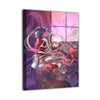
Why Your Favorite Anime Art Looks Better on Acrylic Than a Poster

Why Your Favorite Anime Art Looks Better on Acrylic Than a Poster

, 9 min reading time

That anime poster you ordered looked nothing like the art on screen. Here's why — and why acrylic is the medium anime illustration was always meant to be printed on. A fan's guide to displaying anime art the right way.

You know the feeling. You find a piece of anime art that hits differently — a character moment, a battle scene, a quiet illustration that captures exactly why you fell in love with the series. You want it on your wall. So you order a poster.

It arrives. You hang it. And something is off.

The colors aren't quite right. The gradients look flat. The linework that was so crisp on screen looks soft and a little muddy. The whole thing feels like a photocopy of the art you actually wanted.

This isn't bad luck. It's physics. And once you understand why it happens, you'll never buy an anime poster again.

Anime and Fan Art Was Built to Glow

Anime illustration isn't just drawing. It's a specific visual language built around light.

Think about what makes great anime art great. The way a character's eyes catch the light. The atmospheric glow behind a full moon. The way a fire technique lights up the surrounding darkness. The gradient from deep shadow to brilliant highlight that gives a scene its emotional weight.

Every one of those elements is built in light. Digital anime artists work in RGB color space — a system that uses red, green, and blue light to create color. On a screen, those colors are luminous. They glow. They have a depth and vibrancy that feels almost three-dimensional.

Paper doesn't glow. Paper absorbs ink and reflects ambient light back at you. And when you try to translate a medium built on luminosity into a medium built on absorption, something gets lost. Usually everything that made the art special in the first place.

What a Poster Actually Does to Anime Art

A standard anime poster — the kind you find on Amazon, at conventions for $15, or from most print-on-demand sellers — is printed on paper with CMYK ink. CMYK is a four-color ink system designed for documents and photographs. It was not designed for the color range that anime illustration lives in.

Here's what happens when anime art hits paper:

The gradients flatten. Anime illustration relies heavily on smooth color transitions — the kind that create atmospheric depth and emotional mood. Paper ink can't reproduce the full range of those transitions. What was a luminous fade from deep violet to electric blue becomes a muddy, banded approximation.

The highlights disappear. In digital anime art, highlights are created with light — they literally glow on screen. On paper, highlights are just the absence of ink. There's no glow. There's no luminosity. There's just white paper showing through, which looks flat and lifeless compared to what the artist intended.

The linework softens. The razor-sharp linework that defines anime character design — the clean edges, the precise detail, the intentional weight variation — requires a substrate that can hold fine detail without bleeding or softening. Paper, especially the coated paper used for most posters, doesn't hold that detail the way a rigid substrate does.

The colors shift. The conversion from RGB (screen) to CMYK (print) is never perfect. Colors that were vivid and saturated on screen can shift toward duller, cooler, or darker versions of themselves on paper. Neons become pastels. Deep blues become grey. The emotional impact of the color palette gets quietly undermined.

You paid for the art. The poster gave you a shadow of it.

Why Acrylic Is the Natural Home for Anime Art

3mm Ultra-HD face-mounted acrylic is, in our experience at Snapping Turtle Gallery, the single best medium for anime illustration. Not because it's the most expensive option. Because it's the most honest one — it shows you the art the way the artist actually made it.

It recreates the glow. Acrylic face-mounting places a crystal-clear 3mm panel directly over the print surface. Light passes through the acrylic and reflects back through it, creating a depth and luminosity that no paper print can match. Colors appear to glow from within the panel — exactly the way they glow on a screen. For anime art built around light and atmosphere, this isn't a nice-to-have. It's the whole point.

It preserves the gradients. Our Ultra-HD printing process reproduces color gradients at a resolution and color depth that captures the full range of anime's atmospheric transitions. The fade from shadow to highlight. The atmospheric haze behind a distant mountain. The subtle color shift in a character's hair. All of it comes through clean and complete.

It holds the linework. The rigid acrylic substrate holds fine detail without softening or bleeding. The linework that defines your favorite character — the precise edges, the intentional weight, the clean geometry — stays exactly as sharp as the artist drew it.

It handles the color range. We optimize every print for the specific substrate it's going on. Acrylic renders color differently than paper, and we account for that in our color process. The result is a print that preserves the saturation and vibrancy of the original digital file — not a CMYK approximation of it.

When you hang an acrylic print of anime art on your wall, it doesn't look like a poster. It looks like a window into the scene.

Metal: For the Dark Side of Anime

Not all anime art is luminous and warm. Some of the most powerful anime illustration lives in darkness — and for that, metal is the answer.

Dye-sublimated metal prints use a process that heat-infuses ink directly into a 1mm aluminum panel. The result is a finish with extraordinary contrast — deep blacks that stay deep, bright highlights that stay bright, and a surface that catches directional light in a way that makes dark-palette art look cinematic.

If your favorite series leans toward the dramatic end of the spectrum — the kind of art where the darkness is as important as the light — metal does something acrylic can't. It makes the shadows feel intentional. Heavy. Real.

Metal is the right call for:

  • Attack on Titan's brutal, high-contrast battle scenes
  • Demon Slayer's flame and water technique art
  • Jujutsu Kaisen's dark atmospheric illustrations
  • Chainsaw Man's raw, graphic visual style
  • Any anime art where deep blacks and bright highlights are doing the emotional heavy lifting

The Lightbox Factor: When You Want the Full Experience

Here's something most collectors don't discover until they've already been printing for a while: the room matters as much as the print.

Anime art is designed to be viewed on a backlit screen. In a room without strong natural light or directional accent lighting, even a premium acrylic print can look quieter than it should. The colors are still there. The detail is still there. But the glow — the thing that makes anime art feel alive — needs light to work.

Our Lightbox Frames solve this completely. A lightbox frame backlights your print from behind, recreating the luminous, screen-like quality that makes anime art look its best in any room, at any time of day. For collectors who want the full experience — the glow, the depth, the presence — a lightbox frame isn't an upgrade. It's the destination.

Size Matters More Than You Think

One of the most common mistakes anime collectors make is going too small. Anime illustration is built with detail. The more wall space you give it, the more of that detail you get to actually see.

Our recommendation for most anime wall art: 8" × 10" or 11" × 14" for a desk or shelf display; 16" × 20" or 18" × 24" for a bedroom or living room statement piece; 20" × 28" or larger for collectors who want the art to own the room. We also offer convention sizes — 11" × 17" and 18" × 24" — for artists and collectors who display at fan events.

STG's Anime Collection

We've built our anime collection around the series and characters that matter most to fans — and we print every piece on the substrates that actually do the art justice. Browse our full Anime Wall Art collection and find the piece that belongs on your wall. Every print is made to order, ships with flat-rate pricing, and arrives ready to hang.

If you're bringing your own file — a commission, a purchased digital piece, or an artist's original work — visit our Custom Printing collection and we'll handle the rest. And if you want to go deeper on file prep and medium selection, read our full guide: From Screen to Stone: The Ultimate Guide to Printing Digital Art on Acrylic and Metal.

FAQ

Is acrylic worth it for anime wall art?

Yes — unequivocally. Anime illustration is built around light, color, and atmospheric depth. Acrylic face-mounting is the only print medium that recreates those qualities on a wall. If you care about the art, acrylic is worth it.

What's the difference between acrylic and a regular poster for anime art?

A poster prints on paper with CMYK ink — a process that flattens gradients, softens linework, and shifts colors away from the original. Acrylic face-mounting preserves the full color range, holds fine detail, and adds a luminous depth that makes the art glow the way it does on screen.

Which anime series look best on metal vs. acrylic?

Acrylic is best for series with rich color palettes and atmospheric lighting — Demon Slayer, My Hero Academia, One Piece, Naruto, Studio Ghibli-style illustration. Metal is best for high-contrast, dark-palette series — Attack on Titan, Chainsaw Man, Jujutsu Kaisen, Berserk.

What size should I get for anime wall art?

For a bedroom or living room statement piece, 16" × 20" or 18" × 24" is the sweet spot. For a desk or shelf display, 8" × 10" or 11" × 14" works well. When in doubt, go bigger — anime art rewards the extra wall space.

Can I print a commissioned anime piece with you?

Absolutely. If you have a digital file from an artist, visit our Custom Printing collection and upload your file at checkout. We review every file before printing and reach out if anything needs attention before we proceed.

Do you offer lightbox frames for anime prints?

Yes — our Lightbox Frames are available in multiple sizes and are designed specifically for high-color, high-detail digital art. For anime illustration, a lightbox frame is the ultimate display option.

Snapping Turtle Gallery produces premium wall art for collectors, artists, and fans. All custom prints are made to order. Not affiliated with or endorsed by any franchise rights holders.

STG NEWS

Login

Forgot your password?

Don't have an account yet?
Create account