
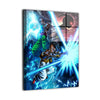
Dragon Ball Z Wall Art: The Collector's Guide
, 10 min reading time
, 10 min reading time
Dragon Ball Z produces more collector-grade wall art than almost any other anime series because the visual language of the franchise is so strong and so immediately recognizable.
Dragon Ball Z produces more collector-grade wall art than almost any other anime series because the visual language of the franchise is so strong and so immediately recognizable. Super Saiyan transformations, Spirit Bomb compositions, the full Z-Fighter roster assembled — these are images that fans have been living with for decades and that translate exceptionally well to large-format acrylic.
Acrylic is the strongest format for most DBZ art because the golden energy of Super Saiyan auras, the blue-white intensity of Spirit Bomb, and the bold color palettes of the franchise all benefit from the depth and luminosity that acrylic amplifies. Metal works well for darker compositions and villain pieces. Canvas works for softer character portraits.
✔ You grew up with DBZ and want the character or moment that defined the series for you represented at the highest possible level on your wall.
✔ You're building a gaming room, streaming setup, or collector space and want art that matches the energy of the space.
✔ You want a display piece that other DBZ fans immediately recognize and respond to.
✔ You're buying a gift for a Dragon Ball Z fan — DBZ is one of the most universally recognized anime franchises and the pieces that resonate most are immediately obvious to fans.
Dragon Ball Z's visual language is built around transformation, power, and spectacle. Every major moment in the series is defined by a visual event — a character's hair turning gold, an energy aura expanding outward, a power level that physically changes the environment around the fighter.
These visual events are exactly what acrylic amplifies. The golden glow of Super Saiyan hair reads as actual light on acrylic rather than flat color. The blue-white intensity of a Spirit Bomb has depth and luminosity that a poster can't approach. The energy effects that define DBZ's most iconic moments are designed to be spectacular, and the acrylic format delivers that spectacle in a way that no other wall art format matches.
The franchise also has one of the strongest character rosters in anime for wall art purposes. Goku, Vegeta, Gohan, Piccolo, Frieza, Cell, Buu — each character has a distinct visual identity, a distinct power set, and a distinct emotional resonance for fans who grew up with the series. That diversity of strong characters means the DBZ catalog produces compelling pieces across a wide range of collector preferences.
Understanding why certain DBZ pieces resonate requires understanding the moments that defined the series for fans. This isn't background — it's the reason specific pieces hold their meaning on a wall for years while others feel generic after a few months.
Raditz arrives on Earth and the world of Dragon Ball changes permanently. Goku dies for the first time. Gohan's hidden power emerges. Piccolo becomes an unlikely ally. The Saiyan Saga established the stakes of the series and introduced the concept of power levels that would define DBZ's narrative structure for the rest of its run. Pieces from this era capture the raw, unpolished energy of the series before the transformations began.
Goku's Super Saiyan transformation on Namek is the single most iconic moment in Dragon Ball Z history. The golden hair, the teal eyes, the energy aura that cracks the ground beneath him — it's the image that defined the franchise for an entire generation of fans. Pieces depicting this moment carry the weight of that history.
Frieza himself is one of the strongest villain designs in anime — elegant, cold, and visually distinctive across all four of his forms. Frieza wall art suits metal particularly well because the precision and contrast of the format matches the character's aesthetic.
Gohan's Super Saiyan 2 transformation during the Cell Games is the emotional peak of the series for many fans. The moment when a child surpasses his father, driven by rage rather than ambition, is one of the most powerful character moments in anime. Pieces depicting Gohan's Cell Games transformation carry that emotional weight and resonate most strongly with fans who grew up watching it happen.
The Buu Saga introduced Fusion — Gogeta and Vegito — and Super Saiyan 3, the most visually dramatic transformation in the original series. Vegito and Gogeta pieces appeal to fans who want the fusion characters — the combination of Goku and Vegeta's power into a single entity.
Dragon Ball Super expanded the transformation roster significantly. Super Saiyan Blue (SSGSS), Ultra Instinct, and Super Saiyan God introduced new color palettes and new visual identities for Goku and Vegeta. These newer transformations suit acrylic exceptionally well because the silver and blue palettes of Ultra Instinct and SSGSS interact with the format's luminosity in ways that the golden Super Saiyan palette does.
Any piece depicting Goku's Super Saiyan transformation — the original on Namek, Super Saiyan 3, Super Saiyan Blue, or Ultra Instinct — is a foundational DBZ collector piece. These are the moments that defined the franchise and the pieces that hold their meaning on a wall for years. Acrylic is the only format that does the energy auras and color palettes of these transformations full justice.
His arc from villain to anti-hero to reluctant ally to genuine hero is one of the strongest character journeys in anime. Pieces that capture Vegeta's pride — the crossed arms, the smirk, the Saiyan armor — resonate with fans who see themselves in his refusal to accept second place. Vegeta pieces work well in acrylic for his powered-up forms and in metal for his more stoic, commanding poses.
The full Z-Fighter roster assembled — Goku, Vegeta, Gohan, Piccolo, Trunks, Krillin, and the rest — is the statement piece for collectors who want the scope of the series represented rather than a single character. These ensemble pieces need large formats to work. The character detail in a full-roster composition gets lost at 16x20. Go 24x36 or larger. Acrylic is the format that gives each character visual separation within the ensemble.
Gohan's Cell Games transformation is the piece for fans who believe Gohan should have been the main character of the series after the Cell Saga. It's a specific piece for a specific type of DBZ fan — and those fans are passionate about it. The emotional weight of the moment makes it one of the most personally meaningful pieces in the DBZ catalog.
Frieza, Cell, and Majin Buu all produce strong wall art for collectors who want the antagonist side of the DBZ universe represented. Villain pieces work well in metal — the precision and contrast of the format suits the visual character of DBZ's antagonists better than the warmth of canvas or the luminosity of acrylic.
Acrylic: The default format for most DBZ art. Super Saiyan auras, Spirit Bomb, energy effects, and the bold color palettes of the franchise all benefit from the depth and luminosity of acrylic. If you're buying one DBZ piece, buy it in acrylic.
Metal: The right choice for villain pieces, darker compositions, and Vegeta's more stoic poses. The precision of dye-sublimated metal suits the visual character of DBZ's antagonists and the cooler, more controlled aesthetic of certain character designs.
Canvas: Works for softer character portraits and atmospheric compositions. Less common in the DBZ catalog because the franchise's visual language is built around energy and intensity rather than warmth and atmosphere.
The strongest DBZ displays are built around a theme rather than assembled randomly. A few approaches that work well:
The Rivalry Wall: Goku and Vegeta as the anchor pair, flanked by their powered-up forms or their fusion counterparts. The Goku/Vegeta rivalry is the emotional core of DBZ and the most natural two-piece setup in the catalog. Same format, same size, flanking a central wall.
The Transformation Timeline: Multiple pieces depicting the same character across their transformation arc — Goku from base form through Ultra Instinct, or Vegeta from Saiyan Saga through Super Saiyan Blue Evolved. This approach rewards fans who know the series well and creates a display that tells a story.
The Full Roster: One large ensemble piece as the anchor, with individual character pieces as supporting art. The ensemble establishes the scope of the series; the individual pieces let you go deeper into the characters that matter most to you.
A Super Saiyan transformation piece in acrylic. The energy effects and color palettes of the transformation moments are where the format shows its biggest advantage, and the moment itself carries the most meaning for most DBZ fans.
Acrylic for most DBZ art — the energy effects, auras, and bold color palettes all benefit from the depth and luminosity of the format. Metal for villain pieces and darker, more stoic compositions.
24x36 for the anchor piece. DBZ art rewards large formats — the energy effects and compositional complexity become more visible as the piece gets larger. Use painter's tape to mark the dimensions on your wall before ordering.
No — STG produces fan art by independent artists. Every piece is clearly attributed to its artist and includes a fan art disclaimer. Fan art is not affiliated with or endorsed by Toei Animation or Shueisha.
Dragon Ball Z pieces depict characters and moments from the original series — Super Saiyan through Super Saiyan 3, the Saiyan through Buu sagas. Dragon Ball Super pieces depict newer transformations — Super Saiyan God, Super Saiyan Blue, Ultra Instinct — and newer story arcs. Both produce strong wall art; the choice depends on which era of the franchise matters most to you.
Fan art by independent artists. Not affiliated with or endorsed by Toei Animation, Shueisha, or Funimation.


Open the product to see the current sizes, format choices, price, and display requirements.


