
Maximum Carnage: Reading Order and Spider-Man's Uneasy Alliance
, 7 min reading time
, 7 min reading time
The fourteen-chapter comic reading order, a compact background route, and the conflict at the heart of Spider-Man and Venom’s alliance.
Spider-Man and Venom can agree that Carnage must be stopped without agreeing on what stopping him should mean. That friction is the most useful starting point for Maximum Carnage, the fourteen-part 1993 comic event. Its uneasy alliance turns a large crossover into a pointed question: how much can you cooperate with someone whose methods you reject?
Begin with Spider-Man Unlimited #1, then follow the chapters across the five participating series. You do not need to read every previous symbiote appearance first. A little background can help, but the event itself is already a substantial reading commitment.
Scope and spoilers: This is a source-based reading guide, not a firsthand critical review. It covers the premise, characters, issue sequence, and themes to watch. It does not reveal the event's resolution. The story includes murder and sustained violence.
The relevant Venom is Eddie Brock, while Carnage is Cletus Kasady. Their symbiotes are connected: Marvel describes Carnage's as offspring of Venom's. That relationship does not make the two hosts the same kind of character. Marvel's symbiote-story retrospective places the Spider-Man/Venom cooperation within a fourteen-part confrontation with Kasady.
For this event, the important distinction is practical. Spider-Man is drawn into cooperation with someone who does not share his limits on lethal force. Carnage and his group create an immediate danger, but that danger does not dissolve the disagreement among those opposing them. The Marvel collection synopsis establishes that conflict.
It is worth keeping the focus this narrow. “Symbiote” names a connection among these characters, not a complete explanation of their choices. Start with who is acting, what they want to prevent, and which methods they consider acceptable. That is more useful than treating the story as a contest between matching powers.
Use the series years below to distinguish similarly named comics. Spider-Man (1990) and The Amazing Spider-Man (1963) are separate titles in this sequence.
Sequence sources: Marvel verifies the included issue set and identifies Spider-Man Unlimited #1 as the starting point. Chapter positions are cross-checked against the Grand Comics Database's story-arc index and collection mapping, with its Epic Collection record confirming the part-five mapping. GCD is a secondary bibliographic source; this sequence is not presented as a reading-order list published by Marvel.
The collection credits multiple writers: Tom DeFalco, J.M. DeMatteis, Terry Kavanagh, and David Michelinie. Its listed pencillers are Mark Bagley, Sal Buscema, Ron Lim, Tom Lyle, and Alex Saviuk. The creative team changes between chapters.
If you read digitally, keep the list nearby when moving between series. If you read a collected edition, check its contents and let the book's sequencing do the work. Do not treat a numerical gap within one title as missing material: the next chapter may simply belong to another series.
Marvel's Spider-Man retrospective says extensive preparation is unnecessary and points to two background stops:
Those are four issues in total, outside the fourteen chapters above. The distinction matters: #344 introduces Kasady, while #361–363 is the early Carnage story.
Choose the extra reading according to your uncertainty. If you mainly need to know who Kasady is, the background route addresses that. If you already understand the characters and want the crossover, begin at Spider-Man Unlimited #1. A useful guide should reduce the barrier to starting, not keep adding prerequisites until the original story disappears beneath them.
Different books named Maximum Carnage can contain different extras. Marvel's Amazing Spider-Man Epic Collection: Maximum Carnage also includes the Spider-Man/Punisher/Sabretooth: Designer Genes one-shot. That is not another chapter to insert into the fourteen-part list. An edition's publication date is also separate from the event's original 1993 publication.
Our interpretation of the premise is that cooperation has two layers. One is immediate: can these characters stop the threat in front of them? The other is ethical: what are they willing to become, or permit, while doing it? Agreement at the first level can conceal a serious disagreement at the second.
That gives the event a useful point of entry even if large casts are not usually your preference. Track the decisions around the alliance rather than trying to rank every participant's strength. Ask who proposes a method, who accepts it, and who refuses. A refusal may matter as much to the character conflict as a successful attack.
Keep consequences in view, too. A plan can appear efficient when judged only by the immediate target. It can look different when judged by the people endangered, the limits abandoned, or the precedent it creates. These are questions to take into the comics, not a substitute for the story's own answers.
There is a limitation to recommending this as an introduction. Fourteen chapters across several titles make it a bigger first step than a compact single-character miniseries. If you want a short encounter with Carnage before deciding, the earlier #361–363 background stop is a smaller commitment. If you want the scale and changing alliances of a crossover, the event is the relevant route.
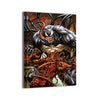
These independent artworks are sold by Snapping Turtle Gallery and shown as catalog display mockups. Neither is verified as a scene from Maximum Carnage. Their value here is thematic: they make the contrast between the two symbiote characters visible without pretending to illustrate the reading list.
Symbiote Showdown, credited to Ryan Pasibe, puts Venom's broad dark upper body above a dense field of Carnage's red-orange tendrils. The overlap makes it difficult to treat either figure as an isolated portrait. Their forms occupy and interrupt one another's space.

Symbiote Reckoning, credited to Ryan Pasibe with colors by Brian Valeza, also known as Totz Valeza, uses a much paler background. That exposes more of the branching silhouettes. The characters remain visually connected, but the surrounding light changes how quickly their shapes separate.

For a closer comparison of the actual images rather than the comic event, see our Venom and Carnage artwork companion. The Carnage artwork collection is another route for readers interested in the character's visual treatment.
For the event, begin with Spider-Man Unlimited #1 and follow the sequence. For background, add #344 and #361–363 first. For the artwork, look at how shape and contrast present the rivalry, without assuming the pictures document a specific battle. Keeping those three purposes separate makes each one more rewarding.
Editorial and rights note: This is STG's own guide, with commercial links to artwork in our catalog. Marvel characters and related names belong to their respective rights holders. The featured artwork is independent fan art, not presented as official or licensed Marvel merchandise. No Marvel affiliation or endorsement is claimed.


