
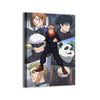
Jujutsu Kaisen Wall Art: The Collector's Guide
, 11 min reading time
, 11 min reading time
Choose the character and composition that mean the most to you, then compare the available finishes and sizes.
Jujutsu Kaisen has the strongest visual identity of any anime series from the 2020s, and Gojo Satoru is the reason. The Six Eyes, the Infinity, the blindfold coming off — Gojo's visual identity is a recognizable in the JJK catalog and one of a possible in modern anime wall art overall. Sukuna is the strongest villain piece in the catalog. Acrylic is the default format for most JJK art because the cursed energy effects, the Domain Expansion sequences, and the bold color palettes of the series benefit from the depth and luminosity of the format. Metal works for Sukuna and the darker, more brutal compositions.
✔ You watched JJK and immediately understood why Gojo became one of the most popular anime characters of the decade — and you want that energy on your wall.
✔ You're on the Sukuna side — the King of Curses, the tattooed face, the absolute certainty that he is the strongest — and you want the villain represented at the same level as the hero.
✔ You're building an anime collector space and want the series that defined the 2020s anime landscape represented at the highest possible quality.
✔ You're buying a gift for a JJK fan. Gojo is the safe choice for most fans. Ask if they're a Sukuna fan before defaulting to the hero side.
Jujutsu Kaisen's visual strength comes from MAPPA's animation quality and Gege Akutami's character designs. The cursed energy effects — the black and purple of Yuji's divergent fist, the blue of Gojo's Infinity, the Domain Expansion sequences that transform the environment into something otherworldly — are designed to be visually spectacular. That spectacle translates directly to wall art.
The character designs are equally strong. Gojo's white hair and the Six Eyes behind the blindfold. Sukuna's tattooed face and the four eyes that appear in his true form. Yuji's pink hair and the Divergent Fist. Megumi's shadow manipulation and the Ten Shadows Technique. Each character has a visual identity that's immediately recognizable and that produces wall art with strong individual identity.
The series also benefits from its villain. Sukuna is the most compelling villain in modern anime for wall art purposes because his visual identity is as strong as the hero roster and his presence in the series is as significant. A JJK display without Sukuna is incomplete for collectors who know the series.
Yuji Itadori swallows Sukuna's finger to save his friends and becomes the vessel for the King of Curses. His journey — to consume all of Sukuna's fingers and be executed, to find meaning in a life defined by someone else's curse — is the emotional core of the series. Yuji's visual identity is defined by his pink hair, his physical strength, and the moments when Sukuna's tattoos appear on his face during possession. Yuji pieces work well in acrylic for the Divergent Fist energy effects and the cursed energy compositions.
Gojo Satoru is the most popular character in JJK and one of the most popular anime characters of the 2020s. His Six Eyes — the blue irises that see cursed energy in ways no other sorcerer can — and his Infinity — the automatic defense that makes him effectively untouchable — create a visual identity that's unlike anything else in anime. The blindfold coming off, the Six Eyes revealed, the Hollow Purple — these are the images that define Gojo for collectors.
Gojo pieces are a possible in the JJK catalog by a significant margin. The white hair, the blue eyes, the casual confidence of a man who knows he's the strongest — these elements produce wall art that works independently of knowledge of the series. Acrylic is the format for Gojo pieces — the blue of the Six Eyes and the Infinity effects benefit from the depth and luminosity of the format.
Ryomen Sukuna is an ancient sorcerer known as the King of Curses and the most compelling villain in modern anime for wall art purposes. His tattooed face, the four eyes that appear in his true form, the absolute certainty of his superiority — Sukuna's visual identity is as strong as Gojo's and produces pieces that are recognizable to fans. The Sukuna/Gojo dynamic — the strongest sorcerer and the strongest curse, the inevitable confrontation — is the central tension of the series and a possible two-piece setup in the JJK catalog.
Sukuna pieces work well in both acrylic and metal. The more dynamic, cursed energy compositions suit acrylic. The more commanding, atmospheric poses — Sukuna seated, the tattooed face in shadow, the absolute authority of his presence — suit metal for their precision and contrast.
Megumi Fushiguro's Ten Shadows Technique — the ability to summon shikigami from shadows — creates a visual identity that's distinct from every other character in the series. The shadows, the Divine Dogs, the Mahoraga summoning — these are compositions that suit acrylic for their dark-on-dark visual complexity and the contrast between the shadow effects and the energy of the technique. Megumi's arc — and what Sukuna does with his body — makes him one of the most emotionally significant characters in the series for fans who've followed the story through its later arcs.
Nobara Kugisaki is the third member of the first-year trio and one of the most distinctive character designs in the series. Her Straw Doll Technique — the hammer, the nails, the cursed energy channeled through physical objects — creates a visual identity that's unlike anything else in JJK. Nobara pieces appeal to collectors who want the full first-year trio represented rather than just the male protagonists.
Domain Expansion is the technique that transforms the environment into a sorcerer's or curse's inner world — a space where their techniques are guaranteed to hit. Each Domain has a distinct visual identity: Gojo's Unlimited Void, a space of infinite information that overwhelms the senses. Sukuna's Malevolent Shrine, a Buddhist temple surrounded by slashed bodies. Megumi's Chimera Shadow Garden, a world of shadows and shikigami. Domain Expansion pieces are the most visually spectacular in the JJK catalog and suit acrylic for their complex, otherworldly compositions.
The Shibuya Incident arc is the moment JJK became something different from what it started as. The sealing of Gojo, Sukuna's rampage through Shibuya, the deaths that change the series permanently — this arc is the emotional and narrative peak of JJK and produces some of the most powerful pieces in the catalog. Pieces from the Shibuya Incident carry the weight of what the series is willing to do to its characters and suit collectors who want the full scope of JJK represented.
Acrylic: The default format for most JJK art. Gojo's Six Eyes and Infinity effects, Domain Expansion sequences, Yuji's Divergent Fist, the cursed energy compositions — the bold color palettes and energy effects of the series benefit from acrylic's depth and luminosity.
Metal: The right choice for Sukuna's commanding poses, darker compositions, and pieces where the precision of the format suits the visual character better than acrylic's warmth. Sukuna seated in authority, the tattooed face in shadow, the Malevolent Shrine aesthetic.
Canvas: Less common in the JJK catalog. Works for softer character portraits and atmospheric compositions outside the action sequences.
The Inevitable Confrontation: Gojo and Sukuna as the anchor pair — the strongest sorcerer and the King of Curses, the confrontation the entire series builds toward. Same format, same size, the central tension of JJK in two frames. This is a recognizable two-piece setup in the catalog.
The First-Year Trio: Yuji, Megumi, and Nobara as a themed display — the three characters who start the series together and whose arcs define its emotional core. Acrylic across all three, consistent sizing, the full scope of the first-year class in three frames.
The Domain Wall: Multiple Domain Expansion pieces — Unlimited Void, Malevolent Shrine, Chimera Shadow Garden — as a themed display. The visual diversity of the Domain designs creates a display that's visually spectacular and rewards close attention from fans who know what each Domain represents.
Gojo is a recognizable character in the JJK catalog by a significant margin. His visual identity — the white hair, the Six Eyes, the casual confidence — produces pieces that work as wall art independently of knowledge of the series. Collectors who haven't watched JJK will buy a Gojo piece because it looks compelling. Collectors who have watched JJK will buy a Gojo piece because of what he means to the series.
The Gojo/Sukuna paired display is a recognizable two-piece setup in the catalog.
Nanami's visual identity — the suit, the bandaged face, the quiet competence — and his role in the series produce pieces that resonate most strongly with fans who appreciate the series' adult characters.
A Gojo Six Eyes piece in acrylic for collectors who want the most visually distinctive version of the protagonist. A Gojo/Sukuna paired display for collectors who want the central dynamic of the series represented. A Domain Expansion piece for collectors who want the most visually spectacular JJK composition.
Acrylic for most JJK art — the cursed energy effects and bold color palettes benefit from the depth and luminosity of the format. Metal for Sukuna's commanding poses and darker compositions.
24x36 for the anchor piece. JJK art rewards large formats — the cursed energy effects and Domain Expansion compositions become more visible and more spectacular as the piece gets larger.
No — STG produces fan art by independent artists. Every piece is clearly attributed to its artist and includes a fan art disclaimer. Fan art is not affiliated with or endorsed by Gege Akutami, Shueisha, or MAPPA.
Yuji pieces depict Itadori Yuji — the vessel, the pink-haired protagonist, the Divergent Fist and the cursed energy of a human sorcerer. Sukuna pieces depict Ryomen Sukuna — the King of Curses, the tattooed face, the four eyes, the absolute authority of the strongest cursed spirit in history. Both inhabit the same body for much of the series, but their visual identities are completely distinct.
Fan art by independent artists. Not affiliated with or endorsed by Gege Akutami, Shueisha, or MAPPA.


