
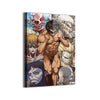
Attack on Titan Wall Art: The Collector's Guide
, 10 min reading time
, 10 min reading time
Choose the character and composition that mean the most to you, then compare the available finishes and sizes.
Attack on Titan produces the most morally complex wall art in anime because the series refuses to give its audience a clean hero. Eren Yeager starts as the protagonist and ends as the antagonist of his own story. Levi Ackerman is the most technically skilled fighter in the series and a possible character in the AoT catalog. Metal is the strongest format for most Attack on Titan art because the series' visual language — dark palettes, high contrast, atmospheric compositions — suits the precision and contrast of the format. Acrylic works for the high-energy ODM gear sequences and the earlier arcs before the series' tone shifts toward its darker conclusion.
✔ You watched AoT and were struck by how different it felt from other anime — the stakes were real, the deaths were permanent, and the story went places you didn't expect.
✔ You want wall art that reflects the moral complexity of the series — not a clean hero vs villain dynamic but the full weight of what AoT is actually about.
✔ You're building a collector space with a darker, more cinematic aesthetic than most anime wall art delivers.
✔ You're buying a gift for an AoT fan. Know where they stand on Eren before you buy — AoT fans have strong, specific opinions about the series' ending and the character's arc.
Attack on Titan's visual strength comes from its atmosphere. The series is built around scale — the Titans are enormous, the walls are enormous, the Survey Corps are tiny figures moving through a world designed to make them feel small. That scale translates directly to wall art. A Survey Corps soldier in ODM gear against a Titan's face, the Wings of Freedom against a grey sky, the Rumbling's wall of Colossal Titans stretching to the horizon — these are compositions designed to communicate scale and weight, and they do it on a wall the same way they do it on a screen.
The series also benefits from its character designs. Levi's blank expression and the precision of his ODM gear movement. Eren's transformation sequence. Mikasa's red scarf and the controlled grief behind her eyes. Armin's tactical mind expressed in the quiet intensity of his face. These are characters designed to communicate emotional complexity without dialogue, and that quality translates to wall art that rewards close attention.
Print life depends on the image, finish, handling, and display conditions. Keep artwork away from prolonged direct sunlight, excess heat, and persistent moisture; no fixed lifespan is promised here.
The Survey Corps — the soldiers who venture beyond the walls to fight Titans — is the visual anchor of the series' middle act. The ODM gear sequences, the Wings of Freedom emblem, the green cloaks against a grey sky — these are the images that define AoT's visual identity for most fans. Survey Corps pieces work well in both acrylic (for the high-energy ODM sequences) and metal (for the more atmospheric, memorial compositions).
Levi Ackerman is the most technically skilled fighter in the series and a possible character in the AoT catalog. His ODM gear sequences — the spinning blades, the impossible speed, the economy of movement that makes every strike look effortless — are the most visually spectacular action sequences in the series. His emotional arc — the losses he accumulates, the squad he fails to save, the cost of being the strongest — gives his pieces weight beyond the action spectacle.
Levi pieces work well in both acrylic and metal. The ODM gear sequences suit acrylic for their energy and movement. The more stoic, commanding poses — Levi standing over a defeated enemy, the blank expression that hides everything — suit metal for their precision and contrast.
Eren's arc is the most discussed character journey in modern anime. He starts as the angry kid who wants to kill every Titan and ends as the man who chose to kill most of humanity to save the people he loves. The moral weight of that arc — and the series' refusal to tell the audience how to feel about it — is what makes AoT different from every other anime series.
Eren pieces span multiple distinct visual identities: the early Eren in Survey Corps gear, the Attack Titan transformation, the War Hammer Titan, and the Founding Titan's skeletal form in the Rumbling. Each version suits a different collector depending on which era of Eren's journey they want represented. Early Eren suits acrylic for the transformation energy. The Rumbling-era Eren suits metal for its dark, apocalyptic aesthetic.
The reveal of Annie Leonhart as the Female Titan is one of the most effective plot twists in anime history. The Warrior Unit — Annie, Reiner, Bertholdt, Zeke — recontextualizes the entire first act of the series and introduces the moral complexity that defines AoT's later arcs. Warrior Unit pieces appeal to collectors who appreciate the series' willingness to make its antagonists as sympathetic as its protagonists.
The Rumbling — Eren's activation of the Wall Titans to flatten the world outside Paradis — is the most visually spectacular sequence in the series and the most morally complex. The wall of Colossal Titans stretching to the horizon, the cities crushed beneath their feet, the Survey Corps chasing their former friend across the sky — these are compositions that suit metal for their dark, apocalyptic scale. Rumbling pieces are a possible from the series' final arc.
Metal: The primary format for most AoT art. The dark palettes, high contrast, and atmospheric compositions of the series suit metal's precision better than acrylic's warmth. Levi's stoic poses, Eren's Rumbling-era compositions, the Titans against a grey sky — metal is the format for AoT's visual identity.
Acrylic: The right choice for high-energy ODM gear sequences, early-series compositions with stronger color, and pieces where the energy and movement of the action suits the format's luminosity. Levi's ODM sequences, the Survey Corps in full flight, the Attack Titan transformation — these suit acrylic for their energy and visual spectacle.
Canvas: Works for the more atmospheric, painterly compositions — the walls at sunset, the Survey Corps assembled before a mission, the quieter character moments between the action. Less common in the AoT catalog but suits certain compositions well.
The Survey Corps Wall: Multiple Survey Corps characters — Levi, Eren, Mikasa, Armin, Hange — as a themed display. The Wings of Freedom emblem and the green cloak create visual coherence across multiple pieces. Metal for the stoic character poses, acrylic for the ODM sequences.
The Protagonist's Arc: Multiple Eren pieces depicting his transformation across the series — early Survey Corps Eren, the Attack Titan, the Founding Titan. A display that tells the full story of the most complex character arc in modern anime.
The Rivals: Levi and Eren as the anchor pair — the soldier who follows orders and the man who decided to give them. The tension between these two characters defines the series' final act and creates a display that captures the full moral weight of AoT in two frames.
Levi is consistently a possible character in the AoT catalog. His ODM gear sequences and his stoic visual identity produce pieces that work as wall art independently of knowledge of the series — they're visually compelling even to people who haven't watched AoT.
Collectors who want early Eren tend to be fans of the series' first act. Collectors who want Rumbling Eren tend to be fans who finished the series and want the full weight of his arc represented.
A Levi ODM gear piece in acrylic for collectors who want the most visually spectacular action in the series. A Levi stoic pose in metal for collectors who want the emotional weight of the character. An Eren transformation piece for collectors who want the protagonist's arc represented.
Metal for most AoT art — the dark palettes and atmospheric compositions of the series suit metal's precision. Acrylic for high-energy ODM sequences and early-series compositions with stronger color.
24x36 for the anchor piece. AoT art rewards large formats — the scale and atmospheric detail become more visible as the piece gets larger.
No — STG produces fan art by independent artists. Every piece is clearly attributed to its artist and includes a fan art disclaimer. Fan art is not affiliated with or endorsed by Hajime Isayama, Kodansha, or MAPPA.
Early Eren pieces depict Izuku Midoriya — wait, wrong guide. Early Eren pieces depict the Survey Corps-era Eren — the angry kid in the green cloak, the Attack Titan transformation, the character before the full weight of his plan becomes clear. Rumbling Eren pieces depict the final-arc Eren — the Founding Titan's skeletal form, the wall of Colossal Titans, the apocalyptic scale of his decision. Both produce strong wall art; the choice depends on which version of the character the collector wants to live with on their wall.
Fan art by independent artists. Not affiliated with or endorsed by Hajime Isayama, Kodansha, or MAPPA.


Open the product to see the current sizes, format choices, price, and display requirements.


