
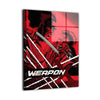
Wolverine Wall Art: The Collector's Guide
, 8 min reading time
, 8 min reading time
Wolverine produces some of the strongest Marvel wall art because the character's visual identity is so immediately recognizable and so emotionally loaded.
Wolverine produces some of the strongest Marvel wall art because the character's visual identity is so immediately recognizable and so emotionally loaded. The claws, the mask, the berserker rage, the quiet moments of exhaustion — every visual element of Wolverine carries decades of story behind it. Acrylic is the strongest format for most Wolverine art because the bold compositions and high-contrast palettes of the character's best pieces benefit from the depth and luminosity of the format. Metal works well for the darker, more brutal compositions.
✔ You've followed Wolverine across comics, films, and animated series and want the character represented at the highest possible level on your wall.
✔ You're building a Marvel collector space and want the character who defines the X-Men represented as the anchor piece.
✔ You want a piece that captures the duality of the character — the berserker and the samurai, the animal and the man, the loner who keeps finding himself surrounded by people worth protecting.
✔ You're buying a gift for a Marvel fan who prefers the street-level, morally complex side of the universe over the cosmic spectacle.
Wolverine's visual identity is one of the most distinctive in comics. The claws are the most recognizable weapon in Marvel history. The mask — the yellow and blue, or the brown and tan, or the black X-Force suit — is immediately identifiable. The berserker pose, claws extended, is a composition that works at any size and in any format.
Print life depends on the image, finish, handling, and display conditions. Keep artwork away from prolonged direct sunlight, excess heat, and persistent moisture; no fixed lifespan is promised here.
Wolverine joined the X-Men reluctantly and has left them multiple times. He keeps coming back because the X-Men represent something he can't find on his own — a family, a purpose, a reason to channel the violence rather than just live in it. His relationship with Professor X, Cyclops, Jean Grey, and the rest of the team is defined by tension and genuine loyalty in equal measure.
X-Men ensemble pieces that include Wolverine work well as statement pieces for collectors who want the full team represented. Wolverine's visual identity is strong enough to anchor an ensemble without dominating it.
Wolverine's time in Japan — his relationship with Mariko Yashida, his training in bushido, his confrontation with the Silver Samurai — is the arc that most clearly defines the samurai side of his character. The contrast between the berserker and the samurai is the central tension of the character, and pieces that capture the Japanese aesthetic — the kimono, the katana, the cherry blossoms against the claws — are among the most visually distinctive in the Wolverine catalog.
X-Force is the black ops team that does the work the X-Men can't officially sanction. Wolverine leads it. The X-Force aesthetic — the black and grey uniform, the moral ambiguity, the willingness to do what's necessary — is a different visual register than the classic yellow and blue X-Men suit. X-Force pieces suit metal for their darker palette and more brutal aesthetic. Collectors who prefer the morally complex side of Wolverine tend to gravitate toward X-Force pieces.
Old Man Logan is the story of an aged Wolverine in a dystopian future where the heroes lost. It's the most emotionally heavy Wolverine story and produces some of the most powerful imagery in the character's history — an old man with grey temples and tired eyes, claws still sharp, still fighting because there's no one else left. Old Man Logan pieces resonate most strongly with long-time fans who have followed the character for decades.
The 2017 film Logan is widely considered the best superhero film of its era and the definitive cinematic treatment of the character. The film's visual aesthetic — dusty, sun-bleached, exhausted — is distinct from the comics and produces wall art that suits collectors who came to the character through the films rather than the comics. Logan film-inspired pieces work well in both acrylic and metal depending on the specific composition.
Acrylic: The default format for most Wolverine art. Classic X-Men suit pieces, berserker rage compositions, and pieces with strong color and energy benefit from acrylic's depth and luminosity. The yellow and blue of the classic suit reads with exceptional intensity on acrylic.
Metal: The right choice for X-Force pieces, Weapon X compositions, Old Man Logan, and any Wolverine art with a darker, more brutal aesthetic. The precision and contrast of metal suits the character's darker visual registers better than the warmth of acrylic.
Canvas: Works for the samurai-era pieces and more atmospheric compositions. The warmth of canvas suits the Japanese aesthetic of the Wolverine/Japan arc better than the intensity of acrylic or metal.
The Duality Display: Classic X-Men suit Wolverine in acrylic as the anchor, X-Force Wolverine in metal as the supporting piece. The contrast between the two visual registers — the hero and the operative — creates a display that captures the full range of the character.
The X-Men Wall: Wolverine as the anchor with other X-Men characters as supporting pieces. Wolverine pairs naturally with Cyclops (the rivalry), Jean Grey (the unrequited connection), and Gambit (the fellow loner). Same format, same size, consistent visual language.
The Berserker and the Samurai: A berserker rage piece in metal flanked by a samurai-era piece in canvas. The contrast between the two sides of the character creates a display that tells the full story of who Logan is.
Wolverine's affiliations are extensive — X-Men, X-Force, Weapon X, the Avengers, Alpha Flight, and more. Collectors building a display around Wolverine have a wide range of companion characters to choose from:
X-23 (Laura Kinney): Wolverine's female clone and eventual successor. X-23 pieces pair naturally with Wolverine for collectors who want the legacy of the character represented alongside the original. See the X-23 section of the X-Men Wall Art collection.
Cyclops: The rivalry between Wolverine and Cyclops is one of the defining tensions of the X-Men. A Wolverine/Cyclops paired display captures that tension in a way that a single character piece can't.
Deadpool: The Wolverine/Deadpool dynamic — the straight man and the chaos agent, the healing factors that make them both unkillable — is one of the most popular pairings in the Marvel catalog. A Wolverine/Deadpool display works well for collectors who want the humor and the violence in equal measure.
The classic X-Men suit berserker pose in acrylic for fans who want the iconic version of the character. An X-Force piece in metal for fans who prefer the darker, more morally complex Wolverine. Old Man Logan for long-time fans who want the emotional weight of the character's full history.
Acrylic for classic X-Men suit pieces and high-energy compositions. Metal for X-Force, Weapon X, and Old Man Logan pieces where the darker palette and more brutal aesthetic suit the format's precision.
24x36 for the anchor piece. Wolverine art rewards large formats — the claw detail and compositional complexity become more visible as the piece gets larger.
No — STG produces fan art by independent artists. Every piece is clearly attributed to its artist and includes a fan art disclaimer. Fan art is not affiliated with or endorsed by Marvel Entertainment or Disney.
X-23 (Laura Kinney) is Wolverine's female clone, created from his DNA by the Weapon X program. She eventually takes on the Wolverine mantle. Both characters share the adamantium claws and healing factor but have distinct visual identities and emotional registers. X-23 pieces pair naturally with Wolverine for collectors who want the full legacy of the character represented.
Fan art by independent artists. Not affiliated with or endorsed by Marvel Entertainment or Disney.

Open the product to see the current sizes, format choices, price, and display requirements.


