
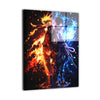
Naruto Wall Art: The Collector's Guide
, 10 min reading time
, 10 min reading time
Naruto produces two distinct eras of wall art with two distinct collector audiences.
Naruto produces two distinct eras of wall art with two distinct collector audiences. The original series — bright, energetic, optimistic — suits acrylic for its bold color and chakra effects. Shippuden — darker, more complex, more atmospheric — splits between acrylic for the high-energy pieces and metal for the darker, more cinematic compositions. The character you love most and the era that defined the series for you determines which pieces belong on your wall.
✔ You grew up with Naruto and want the character or moment that defined the series for you on your wall at the highest possible quality.
✔ You're building an anime collector space and want the series that defined a generation of Western anime fandom represented.
✔ You want a piece that other Naruto fans immediately recognize — the Rasengan, the Sharingan, the Sage Mode silhouette.
✔ You're buying a gift for a Naruto fan. The series has one of the most passionate fan bases in anime and the pieces that resonate most are immediately obvious to anyone who knows the show.
Naruto is unusual among anime franchises in that it has two clearly distinct visual identities that appeal to different collectors for different reasons.
The original series (Episodes 1–220) is bright, energetic, and optimistic. Young Naruto in his orange jumpsuit, Team 7 assembled, the early rivalries and friendships that defined the series' emotional core. The color palette is warm and bold. The compositions are dynamic and forward-moving. This era suits acrylic — the format amplifies the energy and color of the original series' visual language.
Naruto Shippuden (Episodes 1–500) is darker, more complex, and more atmospheric. The characters have grown up. The stakes are higher. The villains are more nuanced. The visual language shifts toward darker palettes, more cinematic compositions, and more emotionally complex character moments. This era splits between acrylic for the high-energy pieces (Sage Mode, Nine-Tails Chakra Mode, the final battle) and metal for the darker, more atmospheric compositions (Itachi's crows, Pain's gravity, Madara's commanding presence).
Naruto Uzumaki starts the series as the village outcast — the kid with the Nine-Tails sealed inside him, shunned by the village that fears what he carries. His dream of becoming Hokage is treated as a joke by everyone around him. The original series is the story of a kid who refuses to give up, who earns respect through sheer determination, and who builds genuine bonds with people who initially want nothing to do with him.
The visual language of this era is defined by the orange jumpsuit, the whisker marks, and the Rasengan — Naruto's signature technique, a spinning sphere of chakra that represents his growth from a kid who couldn't do basic ninjutsu to a genuine shinobi. Pieces from this era carry the optimism and energy of the original series.
Naruto, Sasuke, and Sakura under Kakashi's guidance is the emotional core of the series. The Team 7 dynamic — the rivalry between Naruto and Sasuke, Kakashi's quiet mentorship, the bonds that form under pressure — is what most fans remember most clearly about the original series. Team 7 ensemble pieces are among a possible in the Naruto catalog because they capture the relationship that the entire series is built around.
Sasuke's decision to leave the village and pursue power at any cost is the turning point of the original series and the event that defines Naruto's journey through Shippuden. The Naruto/Sasuke rivalry is one of the most emotionally complex relationships in anime — two people who genuinely care about each other, on opposite sides of a conflict that neither of them chose. Pieces depicting this rivalry — the Valley of the End, the final battle — carry the full weight of that history.
Itachi Uchiha is the character that Naruto fans argue about most passionately, and for good reason. The revelation of his true motivations — that the massacre of the Uchiha clan was an act of sacrifice rather than ambition — recontextualizes everything that came before it. Itachi wall art resonates most strongly with fans who appreciate the series' moral complexity. His visual identity — the Akatsuki cloak, the Sharingan, the crows — is immediately recognizable and suits metal particularly well for its darker, more atmospheric character.
The Pain arc is widely considered the peak of Naruto Shippuden. Nagato's philosophy — that true peace requires understanding pain — is the most coherent villain motivation in the series, and his confrontation with Naruto produces one of the most emotionally resonant moments in anime. Pain's visual identity — the Rinnegan, the piercings, the gravity that bends the world around him — suits metal for its precision and dark palette.
Naruto's power-up moments — Sage Mode with the toad eyes and natural energy, Nine-Tails Chakra Mode with the golden cloak, Kurama Mode with the full Nine-Tails manifestation — are the DBZ-equivalent transformation moments of the Naruto franchise. These are the pieces that suit acrylic best because the energy effects and color palettes of Naruto's transformations benefit from the depth and luminosity of the format.
Madara Uchiha is the most visually commanding villain in the series — a figure of absolute authority and overwhelming power. His visual identity suits metal for its precision and dark palette. Kaguya, the final antagonist, has a more ethereal visual character that works in both acrylic and metal depending on the specific composition.
Acrylic: The default format for original series pieces and Shippuden's high-energy moments. Rasengan, Sage Mode, Nine-Tails Chakra Mode, Team 7 ensemble pieces — the bold color and energy effects of these compositions benefit from acrylic's depth and luminosity.
Metal: The right choice for Shippuden's darker compositions. Itachi's crows, Pain's gravity, Madara's commanding presence, Sasuke's darker post-departure aesthetic — the precision and contrast of metal suits these pieces better than the warmth of acrylic.
Canvas: Works for softer character portraits and atmospheric compositions. Less common in the Naruto catalog but suits certain Kakashi pieces and atmospheric landscape compositions from the series.
The Rivalry Wall: Naruto and Sasuke as the anchor pair — the Valley of the End, or their final battle, or simply the two characters in their most iconic forms flanking a central wall. The Naruto/Sasuke rivalry is the emotional core of the series and the most natural two-piece setup in the catalog.
The Era Split: Original series Naruto in acrylic as the anchor, Shippuden Itachi or Pain in metal as the supporting piece. The contrast between the optimism of the original series and the complexity of Shippuden creates a display that tells the full story of the franchise.
The Akatsuki Wall: Multiple Akatsuki members — Itachi, Pain, Konan, Kisame, Deidara — as a themed display. The Akatsuki's visual identity (the black cloaks with red clouds) creates strong visual coherence across multiple pieces. Metal is the format for this display.
Itachi is a close third — and the collectors who buy Itachi pieces tend to be the most passionate about the series, because appreciating Itachi requires knowing the full story.
The era split in the Naruto catalog is roughly 60/40 in favor of Shippuden over the original series. Collectors who grew up with the original series often want both — the original series piece for nostalgia, the Shippuden piece for the character they became.
Kakashi is consistently underrepresented in collector displays relative to his importance to the series. Fans who buy Kakashi pieces tend to be the most knowledgeable about the series — they're buying the character who made Team 7 what it was, not just the most obvious protagonist.
Naruto with the Rasengan or in Sage Mode for original series fans. Itachi with the Sharingan or in the Akatsuki cloak for Shippuden fans. The Naruto/Sasuke rivalry piece for fans who want the emotional core of the series represented.
Acrylic for original series pieces and Shippuden's high-energy moments. Metal for Shippuden's darker compositions — Itachi, Pain, Madara, and Sasuke's post-departure aesthetic.
24x36 for the anchor piece. Naruto art rewards large formats — the chakra effects and compositional complexity become more visible as the piece gets larger.
No — STG produces fan art by independent artists. Every piece is clearly attributed to its artist and includes a fan art disclaimer. Fan art is not affiliated with or endorsed by Masashi Kishimoto, Shueisha, or Studio Pierrot.
Original series pieces depict younger characters in the brighter, more energetic visual style of the first 220 episodes. Shippuden pieces depict older characters in the darker, more complex visual style of the sequel series. Both produce strong wall art — the choice depends on which era of the franchise matters most to you.
Fan art by independent artists. Not affiliated with or endorsed by Masashi Kishimoto, Shueisha, or Studio Pierrot.

Open the product to see the current sizes, format choices, price, and display requirements.


