
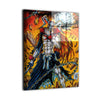
Bleach Wall Art: The Collector's Guide
, 10 min reading time
, 10 min reading time
Choose the character and composition that mean the most to you, then compare the available finishes and sizes.
Bleach has one of the strongest visual identities in anime — the black and white Shinigami robes, the Zanpakuto releases, the Bankai sequences that transform both the weapon and the wielder. Aizen Sosuke is the strongest villain piece in the catalog and one of the best villain designs in shonen history. Metal is the strongest format for most Bleach art because the series' visual language — black robes, high contrast, atmospheric Soul Society compositions — suits the precision of the format. Acrylic works for the high-energy Bankai sequences and the pieces with strong color.
✔ You grew up with Bleach and want the Bankai sequence or the character that defined the series for you on your wall at the highest possible quality.
✔ You're building an anime collector space and want the series that defined the mid-2000s anime landscape — and that came back stronger than ever with the Thousand-Year Blood War arc — represented.
✔ You want a piece with a visual identity that's immediately recognizable to anime fans across generations — Ichigo's black coat and orange hair is one of the most distinctive protagonist designs in the medium.
✔ You're buying a gift for a Bleach fan. Know whether they're an original series fan or a TYBW fan before you buy — the two eras have distinct visual identities and distinct collector preferences.
Bleach's visual strength comes from its design philosophy: every major character has a Zanpakuto with a distinct release form, and every Bankai transforms the wielder's visual identity. Ichigo's Tensa Zangetsu turns his coat black and compresses his power into a single blade. Byakuya's Senbonzakura scatters into a thousand cherry blossom blades. Kenpachi's Bankai turns him into a demon. Each release is designed to be visually spectacular and to communicate something about the character's inner world.
The series also benefits from its setting. Soul Society — the afterlife realm of the Shinigami — has a distinct visual aesthetic: traditional Japanese architecture, black robes against white walls, the Seireitei's towers against a pale sky. That aesthetic creates a visual language that's immediately recognizable and that suits metal for its precision and contrast.
Ichigo Kurosaki is a high school student who becomes a Substitute Shinigami after absorbing Rukia Kuchiki's powers. His journey — from a kid who could see ghosts to the most powerful being in existence — is defined by a series of power-ups that each produce a distinct visual identity. The original Shinigami form. The Bankai black coat. The Hollow mask. The Vasto Lorde form. The Final Getsuga Tensho. The True Shikai in the Thousand-Year Blood War arc.
Each version of Ichigo suits a different collector depending on which era of the series matters most to them. The Bankai black coat is a recognizable — it's the visual identity that defined Ichigo for most fans and the one that reads most strongly as wall art. Acrylic for the Getsuga Tensho energy effects. Metal for the more commanding, atmospheric poses.
The mask represents the duality at the core of the character: the Shinigami and the Hollow, the order and the chaos, the power he was given and the power he took. Hollow mask pieces suit metal for their dark, high-contrast aesthetic.
Sosuke Aizen is a recognizable villain in the Bleach catalog and one of the most compelling villain designs in shonen history. His arc — the trusted captain who was the enemy all along, the man who planned everything from the beginning — is the most effective long-game villain reveal in anime. His visual identity evolves from the gentle captain with glasses to the butterfly-winged Hogyoku fusion to the bound prisoner in the epilogue. Each version produces strong wall art for different reasons.
Aizen pieces suit metal for their dark palette and the commanding authority of the character's visual identity. The butterfly-winged Hogyoku fusion is the most visually spectacular Aizen composition and suits acrylic for its color and energy. The bound Aizen — the prisoner who is still clearly the most dangerous person in the room — suits metal for its atmospheric, high-contrast character.
Byakuya Kuchiki is a recognizable captain in the Bleach catalog after Aizen. His Senbonzakura Bankai — a thousand cherry blossom blades that fill the air around him — is one of the most visually distinctive techniques in the series. The pink petals against the black captain's haori, the cold expression, the absolute certainty of his superiority — Byakuya pieces produce wall art that's immediately recognizable to any Bleach fan. Acrylic for the Senbonzakura petal effects. Metal for the more stoic, commanding poses.
Kenpachi Zaraki is the most physically powerful captain in the Gotei 13 and the character who most clearly represents Bleach's love of pure combat. His visual identity — the eyepatch, the bells in his hair, the massive Zanpakuto, the grin that appears when he's finally facing someone worth fighting — is immediately recognizable. His Bankai — the demon form that turns him into something barely human — is the most visually dramatic captain transformation in the series. Metal is the format for Kenpachi pieces.
The Thousand-Year Blood War arc — adapted by Studio Pierrot with animation quality that rivals the best in the industry — is the visual peak of the Bleach franchise. The Quincy invasion, the Sternritter, Ichigo's true Shikai, the final battles — TYBW produces the most visually spectacular sequences in the series and a possible pieces in the modern Bleach catalog. Collectors who came back to Bleach for TYBW want pieces from this arc specifically.
Rukia Kuchiki is the character whose encounter with Ichigo starts the entire series. Her Shikai — Sode no Shirayuki, the most beautiful Zanpakuto in Soul Society — creates ice techniques with a visual identity that's distinct from every other character in the series. Her Bankai in TYBW — Some no Mai, Tsukishiro — is one of the most visually striking sequences in the arc. Rukia pieces appeal to collectors who want the character who made Bleach what it is represented alongside the protagonist.
Metal: The primary format for most Bleach art. The black robes, high contrast, and atmospheric Soul Society compositions suit metal's precision better than acrylic's warmth. Aizen's commanding poses, Kenpachi's demon Bankai, Byakuya's stoic authority, and most Hollow mask compositions belong on metal.
Acrylic: The right choice for high-energy Bankai sequences, the Senbonzakura petal effects, the Hogyoku fusion compositions, and pieces with strong color. Ichigo's Getsuga Tensho, Byakuya's Senbonzakura in full bloom, and the TYBW sequences with strong color palettes suit acrylic for their energy and visual spectacle.
Canvas: Works for the more atmospheric, painterly compositions — Soul Society at dusk, the cherry blossoms of the Kuchiki estate, the quieter character moments between the battles.
The Shinigami and the Villain: Ichigo and Aizen as the anchor pair — the protagonist and the man who was always ten steps ahead of him. Same format, same size, the central conflict of the series in two frames. Metal for both.
The Captains Wall: Multiple captain pieces — Byakuya, Kenpachi, Aizen, Yamamoto, Ukitake, Kyoraku — as a themed display. The captain's haori creates visual coherence across multiple pieces. Metal across all pieces, consistent sizing.
The Bankai Sequence: Multiple Ichigo pieces depicting his power evolution — Shinigami form, Bankai black coat, Hollow mask, TYBW true Shikai. A display that tells the full story of the most powerful Substitute Shinigami in history.
Ichigo in the Bankai black coat is a recognizable piece in the Bleach catalog. The visual identity is strong enough to work as wall art for people who haven't watched the series — the orange hair against the black coat is immediately striking.
Ichigo in the Bankai black coat in metal for collectors who want the most iconic version of the protagonist. An Aizen piece for collectors who want the villain represented. A Byakuya Senbonzakura piece in acrylic for collectors who want the most visually distinctive technique in the series.
Metal for most Bleach art — the black robes, high contrast, and atmospheric compositions suit metal's precision. Acrylic for high-energy Bankai sequences and pieces with strong color, particularly Senbonzakura and the Hogyoku fusion.
24x36 for the anchor piece. Bleach art rewards large formats — the Bankai effects and atmospheric detail become more visible as the piece gets larger.
No — STG produces fan art by independent artists. Every piece is clearly attributed to its artist and includes a fan art disclaimer. Fan art is not affiliated with or endorsed by Tite Kubo, Shueisha, or Studio Pierrot.
Original series pieces depict characters in the visual style of the 2004–2012 anime — the classic designs, the Soul Society arc, the Arrancar arc. TYBW pieces depict characters in the visual style of the 2022 adaptation — updated designs, significantly higher animation quality, and the final arc's new power levels and transformations. Both produce strong wall art; TYBW pieces reflect the current peak of the franchise's visual identity.
Fan art by independent artists. Not affiliated with or endorsed by Tite Kubo, Shueisha, or Studio Pierrot.

Open the product to see the current sizes, format choices, price, and display requirements.


