
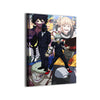
My Hero Academia Wall Art: The Collector's Guide
, 10 min reading time
, 10 min reading time
My Hero Academia produces wall art across two distinct collector audiences — hero fans and villain fans — and the villain side is stronger than most people expect.
My Hero Academia produces wall art across two distinct collector audiences — hero fans and villain fans — and the villain side is stronger than most people expect. Deku, Bakugo, and All Might anchor the hero catalog. Shigaraki, Dabi, and the League of Villains anchor the villain catalog. Acrylic is the strongest format for hero pieces with bold Quirk effects and energy. Metal is the right choice for villain pieces and the darker, more atmospheric compositions. The series has one of the most passionate fan bases in modern anime and the pieces that resonate most are tied to specific character moments rather than generic action poses.
✔ You've followed Deku's journey from Quirkless kid to the greatest hero and want the moment that defined that arc on your wall.
✔ You're on the villain side — you find Shigaraki's decay, Dabi's blue flames, and the League of Villains' philosophy more compelling than the hero course, and you want that represented.
✔ You're building an anime collector space and want the series that defined the superhero genre for a new generation of anime fans.
✔ You're buying a gift for an MHA fan. The series has one of the broadest fan bases in modern anime and the character preferences are strong and specific — ask which side they're on before you buy.
My Hero Academia's visual strength comes from its Quirk system. Every character's power has a distinct visual identity — Deku's green lightning, Bakugo's orange explosions, Todoroki's fire and ice split, Dabi's blue flames, Shigaraki's decay spreading across surfaces. These visual identities are designed to be immediately recognizable and they translate directly to wall art that rewards close attention.
The series also benefits from a character roster that's unusually strong on both sides of the hero/villain divide. Most anime series have compelling heroes and functional villains. MHA has compelling heroes and genuinely interesting villains — characters with coherent philosophies, personal histories, and visual identities that are as strong as the hero roster. That balance produces a catalog that appeals to a wider range of collectors than most anime series.
Izuku Midoriya starts the series as the only person in a world of superpowers who was born without one. His encounter with All Might — the greatest hero, the Symbol of Peace — and the decision to pass One For All to him is the inciting event of the entire series. Deku's journey is the story of someone who was told he couldn't be a hero choosing to become one anyway, and the cost of that choice.
Deku's visual identity evolves significantly across the series. Early Deku — green lightning, the original One For All at 5% and 8% — is a recognizable version for collectors who want the underdog story represented. Later Deku — the dark hero arc, the full cowl at 100%, the mastery of the Quirks inherited through One For All — appeals to collectors who want the completed version of the character. Both produce strong wall art in acrylic.
Katsuki Bakugo starts the series as the bully — the kid who told Deku to jump off a roof, who couldn't accept that someone he looked down on might surpass him. His arc across the series is one of the most compelling character journeys in modern anime — a genuinely terrible person who becomes, through pain and failure and the example of people he can't dismiss, a genuine hero. Bakugo's explosion Quirk — orange-red blasts, the gauntlets, the aggressive forward momentum of his fighting style — produces some of the most visually dynamic pieces in the MHA catalog. Acrylic for the explosion effects. Metal for the darker, more intense compositions from his later arc.
All Might is the greatest hero in the world and the man who passes that responsibility to Deku. His visual identity — the massive muscular form, the American flag color scheme, the smile that never wavers — is the visual anchor of the series' first act. All Might pieces carry the weight of what the series is about at its core: the idea that a hero's job is to make people feel safe. His powered-down form — the skeletal, coughing Toshinori Yagi — is the visual representation of the cost of that responsibility. Both versions produce compelling wall art for different reasons.
Shoto Todoroki's Quirk — fire on the left, ice on the right, the scar across his eye — is one of the most visually distinctive designs in the series. His refusal to use his fire side because it was given to him by his abusive father, and his eventual decision to use it on his own terms, is the emotional core of his arc. Todoroki pieces that capture the fire/ice split — the visual tension between the two sides of his power — are among a possible in the MHA catalog. Acrylic for the full fire/ice composition.
The League of Villains is the strongest villain roster in modern anime for wall art purposes because every member has a distinct visual identity and a coherent reason for being a villain. Shigaraki's decay hands and the All For One connection. Dabi's blue flames and the Todoroki family secret. Toga's obsession and the knives. Twice's mask and the identity crisis. Each character produces compelling wall art for collectors who want the villain side of the series represented.
Shigaraki is a recognizable villain in the MHA catalog — the decay Quirk spreading across surfaces, the hands covering his body, the evolution from Tomura to the completed vessel of All For One. Metal is the format for Shigaraki pieces. Dabi's blue flames are the most visually distinctive villain effect in the series and suit acrylic for their color intensity — the blue-white flame against dark backgrounds reads with exceptional depth on the format.
The U.A. Sports Festival arc is the moment the series establishes its full character roster and the rivalries that will define the rest of the series. Deku vs Todoroki — the fight where Todoroki finally uses his fire side — is the most emotionally resonant battle in the series and produces some of a possible MHA pieces. The Sports Festival aesthetic — the stadium, the crowd, the full hero course assembled — suits ensemble pieces for collectors who want the scope of the series represented.
Acrylic: The default format for hero pieces with strong Quirk effects. Deku's green lightning, Bakugo's explosions, Todoroki's fire/ice split, Dabi's blue flames — the bold color and energy effects of these compositions benefit from acrylic's depth and luminosity.
Metal: The right choice for villain pieces and darker compositions. Shigaraki's decay, the League of Villains assembled, and the darker moments of the hero arc suit metal's precision and contrast better than acrylic's warmth.
Canvas: Works for softer character portraits and atmospheric compositions. Less common in the MHA catalog but suits certain All Might pieces and the quieter character moments between the action sequences.
The Rival Wall: Deku and Bakugo as the anchor pair — the Quirkless kid and the explosive prodigy, the two sides of what it means to be a hero in the MHA universe. Same format, same size, the rivalry that defines the series in two frames.
The Hero vs Villain Split: Hero pieces in acrylic on one wall, villain pieces in metal on another. The visual contrast between the two formats reinforces the thematic contrast between the two sides of the series. This is the most ambitious MHA display approach and the most rewarding for fans who appreciate both sides of the story.
The Class 1-A Ensemble: Multiple Class 1-A characters as a themed display — Deku, Bakugo, Todoroki, Uraraka, Iida, and the rest of the hero course assembled. The visual diversity of the class designs creates a display that's rich without being chaotic.
Todoroki is a close third. The hero/villain split in the catalog is roughly 65/35 in favor of hero pieces, but the villain pieces have a more passionate buyer — collectors who want villain art tend to know exactly what they want and buy with more conviction than the average hero piece buyer.
Dabi is a recognizable villain character, driven by the Todoroki family reveal and the blue flame visual identity. Shigaraki is second, with demand that increases significantly after the Paranormal Liberation War arc.
A Deku One For All piece in acrylic for hero fans. A Shigaraki or Dabi piece in metal or acrylic for villain fans. The Deku/Bakugo rivalry pair for collectors who want the central dynamic of the series represented.
Acrylic for hero pieces with strong Quirk effects. Metal for villain pieces and darker compositions. Dabi is the exception — the blue flame visual identity suits acrylic for its color intensity.
24x36 for the anchor piece. MHA art rewards large formats — the Quirk effects become more visible and more spectacular as the piece gets larger.
No — STG produces fan art by independent artists. Every piece is clearly attributed to its artist and includes a fan art disclaimer. Fan art is not affiliated with or endorsed by Kohei Horikoshi, Shueisha, or Bones.
Early Deku pieces depict Izuku Midoriya in the original One For All — green lightning, the U.A. uniform, the underdog energy of the series' first act. Dark hero arc pieces depict the later Deku — the torn costume, the full mastery of inherited Quirks, the isolation of carrying the weight of One For All alone. Both produce strong wall art; the choice depends on which version of the character resonates most with you.
Fan art by independent artists. Not affiliated with or endorsed by Kohei Horikoshi, Shueisha, or Bones.

Open the product to see the current sizes, format choices, price, and display requirements.


